
As cities accelerate the transition to energy-efficient lighting, the focus is often on replacing old luminaires with new LED fixtures. While this approach can deliver performance improvements, it often overlooks a critical factor: the environmental cost of replacing entire luminaires instead of upgrading existing ones.
At Luxega, we take a different approach—one that prioritizes material reduction, CO₂ savings, and responsible reuse of existing infrastructure.
Material Savings: A Hidden Opportunity in Street Lighting
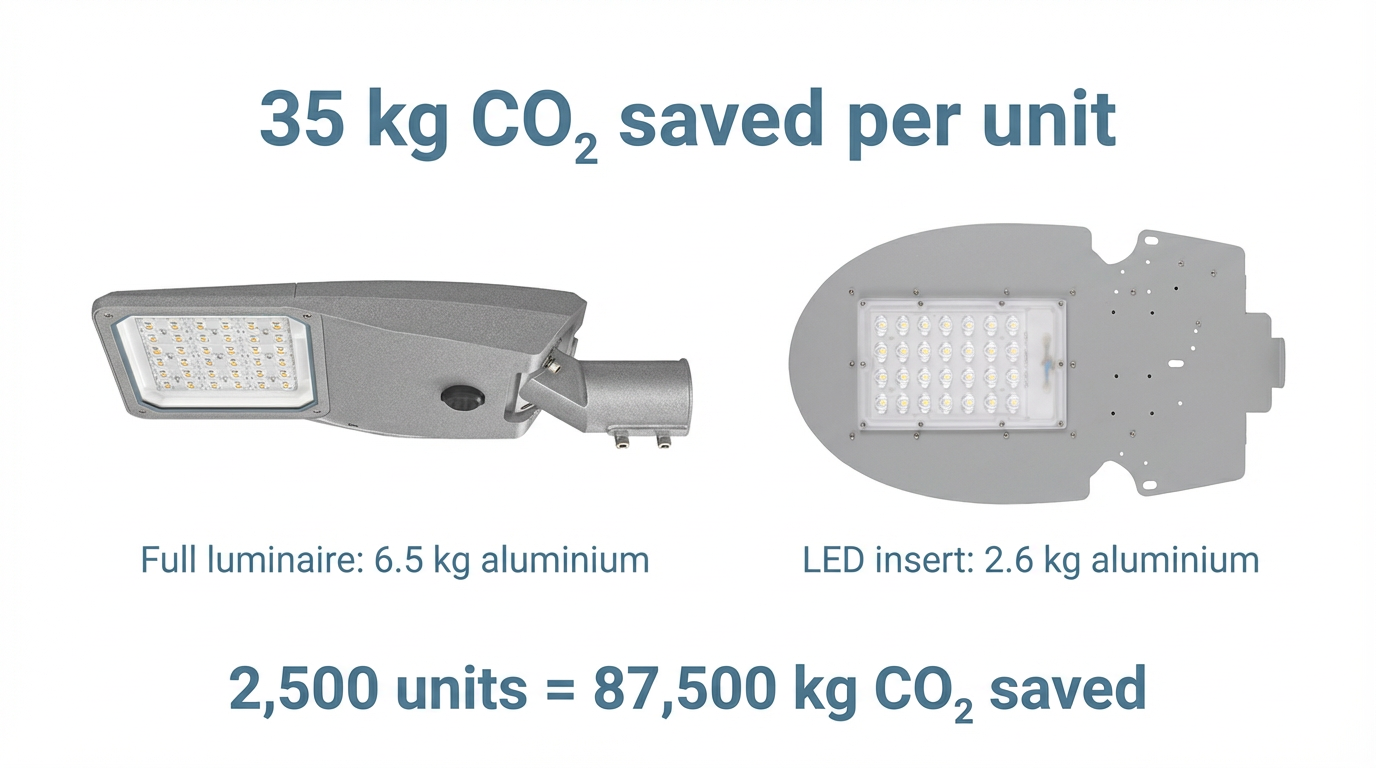
A typical street luminaire contains a significant amount of aluminium—one of the most energy-intensive materials to produce.
From the example shown:
Full luminaire: 6.5 kg aluminium
LED insert: 2.6 kg aluminium
This results in a material reduction of 3.9 kg aluminium per unit.
Aluminium production has a high carbon footprint. When translating this into CO₂ impact:
CO₂ saving per unit: 35 kg CO₂
Project example (2,500 units):
→ 87,500 kg CO₂ saved
This is a substantial reduction—achieved simply by upgrading instead of replacing.
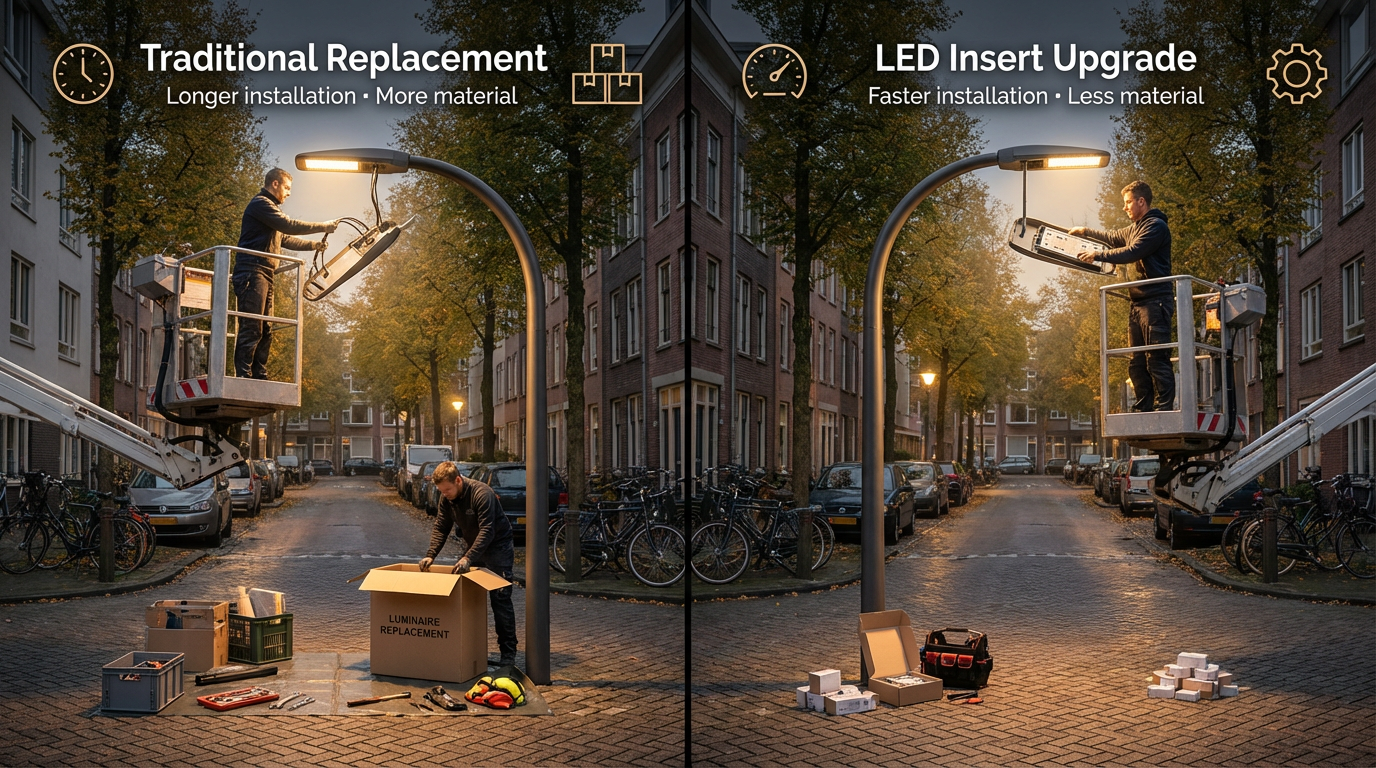
Installation Efficiency = Additional CO₂ Savings
Material savings are only part of the story. Installation time also plays a major role in overall environmental impact.
LED Insert Installation
Time: 2 minutes 36 seconds (~2.6 minutes)
Full Luminaire Replacement
Time: 15–30 minutes (average ~22.5 minutes)
Time Saved Per Installation
~20 minutes saved per unit
For a project with 2,500 luminaires:
Total time saved:
→ 50,000 minutes (~833 hours)
This directly reduces:
Lift operation time
Energy consumption
Labor costs
Traffic disruption
CO₂ Impact from Installation
Assuming:
A service lift + vehicle emits approx. 15–25 kg CO₂ per hour
Then:
833 hours saved = 12,500 – 20,800 kg CO₂ saved
Total CO₂ Savings: Material + Installation
Combining both effects:
Material savings: 87,500 kg CO₂
Installation savings: up to ~20,800 kg CO₂
Total Potential Saving
→ Over 100,000 kg CO₂ for a 2,500-unit project
When Should You Replace vs. Retrofit?
It’s important to note that retrofit is not always the right solution.
If an existing luminaire:
Has structural damage
Cannot meet safety standards
Has severe corrosion or electrical risks
Then replacement is the correct approach.
However, in many cases, existing housings are still mechanically sound—and represent a valuable asset.
Safety First: Luxega’s Responsibility
At Luxega, safety is non-negotiable.
We only deliver LED insert solutions when we can ensure that:
The luminaire structure is safe
Thermal management is fully controlled
Electrical components meet all standards
The complete solution complies with relevant certifications
This means that the responsibility does not fall on the installer or municipality—it remains with us.
Our retrofit solutions are engineered not just for performance, but for long-term operational safety in real-world conditions.
Why LED Retrofit is the Future of Sustainable Street Lighting
The lighting industry is at a turning point.
While many manufacturers focus on selling new luminaires, the most sustainable solution is often to reuse what already exists.
LED retrofit enables:
Significant CO₂ reduction
Lower material consumption
Faster installation
Reduced costs
Extended asset lifetime
Conclusion
Upgrading street lighting is not just about energy efficiency—it’s about making responsible choices across the entire lifecycle.
By choosing LED inserts instead of full luminaire replacement, cities can:
Reduce environmental impact
Maintain high performance
Ensure safety
Optimize budgets
At Luxega, we believe the smartest upgrade is not always the newest product—but the most sustainable solution.
Interested in reducing CO₂ while upgrading your street lighting?
Contact Luxega to explore retrofit solutions tailored to your project.