
The EU Phase-Out Clock Is Ticking
What Municipalities Must Know About Street Lighting Regulations
Every year, millions of street lamps across Europe burn through the night on technology that is being outlawed. Mercury vapour lamps, high-pressure sodium lamps, metal halide lamps — the conventional light sources that have illuminated European streets for decades are now the subject of a sweeping regulatory phase-out driven by the EU's environmental agenda.
For municipalities and public infrastructure managers, this is not a distant problem. The deadlines are here, or arriving within months. And the financial stakes are significant.
This article provides a complete, regulation-backed overview of which lamp types are being phased out, when, and what the smartest path forward looks like.
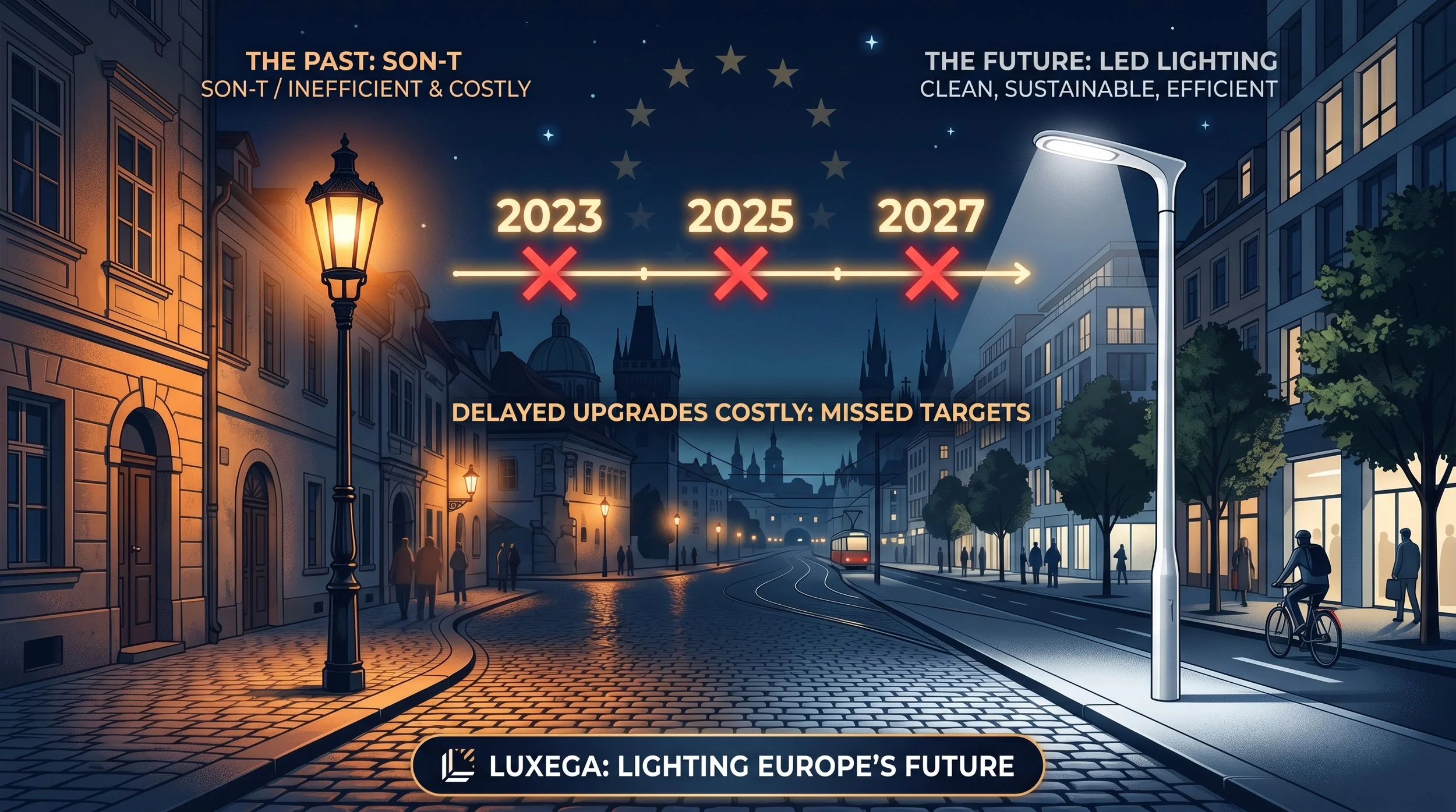
The Regulatory Framework: Three Directives You Need to Know
The phase-out of conventional light sources in the EU is governed by three complementary pieces of legislation.
EU Ecodesign Regulation (EC) No 245/2009 and Regulation (EU) 2019/2020 Sets minimum energy performance requirements for light sources. Inefficient lamp types that fail to meet these standards are banned from being placed on the EU market.
RoHS Directive (2011/65/EU) and Amendment Directives (EU) 2022/275–2022/284 Restricts the use of hazardous substances — including mercury — in electrical and electronic equipment. Exemptions for mercury-containing lamps are time-limited and are now expiring.
EU Mercury Regulation (EU) 2024/1849 Published 10 July 2024, this regulation introduces a hard phase-out of the manufacturing and export of mercury-containing lamps — closing the door even on production destined for markets outside the EU.
Together, these regulations effectively end the era of conventional discharge lighting on European streets.
Already Banned — No Longer Available
These lamp types can no longer be placed on the EU market:
High-pressure mercury vapour lamps (HQL/MBF) — banned since 1 April 2015
Low-pressure sodium vapour lamps — banned since 1 April 2015
Incandescent lamps (all wattages) — phased out between 2009 and 2012
Compact fluorescent lamps with integrated ballast — banned since 1 September 2021
Linear fluorescent T5 and T8 — banned since 25 August 2023
The classic HQL/MBF mercury vapour lamp — once the backbone of European street lighting — has been banned from sale since April 2015. Any municipality still operating these lamps is running on ageing stock that cannot be legally replaced with equivalent technology. Replacement is not optional. It is overdue.
Banned Since 2023 — Check Your Procurement Records
High-pressure sodium (HPS/SON-T) 250W and 400W exceeding mercury content limits — banned from 24 February 2023
Compact fluorescent lamps without integrated ballast — banned from 25 February 2023
The iconic amber glow of the SON-T is still visible on millions of European streets. The 250W and 400W variants — among the most widely used in road and area lighting — were banned from new market placement in February 2023. Municipalities relying on these for ongoing procurement will already be encountering supply difficulties and rising prices.
Expired End of 2025 — Immediate Action Required
These lamp types passed their manufacturing and export deadline on 31 December 2025:
Remaining high-pressure sodium (HPS/SON-T) wattages exceeding mercury thresholds — including many of the most commonly deployed street lighting variants
Linear halophosphate fluorescent lamps (standard T8)
Non-linear halophosphate fluorescent lamps
Compact fluorescent lamps for general lighting
This is the critical deadline for most municipalities. Stock runs out. Spare parts become scarce. Emergency replacements become expensive and logistically complicated. If your infrastructure still depends on these lamp types, the time to act is now.
Expiring End of 2026 — Plan Now
Linear triband phosphor fluorescent lamps (T5 high-efficiency, T8 triphosphor) — phase-out 31 December 2026
Non-linear triband phosphor fluorescent lamps — phase-out 31 December 2026
2027 — The Final Window for Metal Halide and Remaining HPS
Metal halide lamps (HQI/HCI) for outdoor and street lighting currently hold RoHS exemptions valid until at least February 2027. However, a formal review is underway — the European Parliament submitted a question to the Commission in April 2026 regarding whether these exemptions will be extended beyond that date. The outcome is not yet decided.
Remaining low-mercury high-pressure sodium variants are under the same RoHS review process.
Planning infrastructure upgrades based on a possible exemption extension is a high-risk strategy for public procurement managers. The direction of travel is clear and has been for years.
What This Means in Practice
The phase-out is not purely theoretical. Here is what it means on the ground:
Supply chain disruption is already underway. Lamp manufacturers have been winding down production of banned products. Lead times for SON-T and metal halide replacement lamps are increasing, and prices are rising as scarcity takes hold.
Maintenance becomes a liability. Every month a municipality continues to operate a banned lamp type, it moves closer to a scenario where a lamp failure cannot be remedied with a like-for-like replacement. Emergency retrofits under pressure are always more expensive than planned transitions.
Energy costs remain needlessly high. High-pressure sodium lamps typically deliver 80–130 lumens per watt. Modern LED street lighting delivers 140–180+ lumens per watt — a 30–50% efficiency advantage, before accounting for reduced maintenance intervals and longer service life.
Regulatory exposure is real. Public procurement rules in many EU member states require compliance with current market regulations. Operating a non-compliant lighting infrastructure is increasingly difficult to justify in audit and procurement cycles.
The Retrofit Opportunity: Half the Cost, Full Compliance
The conventional approach to upgrading street lighting — removing the entire luminaire and installing a new complete fixture — is expensive, disruptive, and often delays projects by years in the municipal budget cycle.
LED retrofit conversion changes this equation.
A retrofit conversion replaces only the internal light source and driver within the existing luminaire housing. The pole, the housing, the electrical connection — all of that stays in place. The cost is typically 40–60% lower than a full luminaire replacement, with the same end result: full LED performance, full regulatory compliance, full energy savings.
For a municipality managing 5,000 street points, this difference can represent millions in project cost — and the ability to complete the transition in a single budget cycle rather than spreading it over five to eight years.
Key Takeaways
Mercury vapour lamps (HQL): banned since April 2015. Any remaining installations are operating on obsolete, irreplaceable stock.
High-pressure sodium SON-T 250W/400W: banned from new market placement since February 2023.
Remaining SON-T variants: manufacturing and export phase-out reached December 2025.
Metal halide (HQI/HCI): RoHS exemption valid until at least February 2027, but under active review — no guarantee of extension.
The smart move: plan your LED transition now, before supply shortages and emergency procurement costs escalate.
About Luxega
Luxega is a professional LED lighting supplier specialising in outdoor and street lighting solutions for municipalities, road authorities, and infrastructure contractors across Denmark, Sweden, and Germany. Our LED retrofit programme is designed to deliver full regulatory compliance and maximum energy savings at a fraction of the cost of full luminaire replacement.
Contact us for a free lighting assessment and energy optimisation report.
🌐 Book a meeting or 📞 +45 66 46 99 90
Sources: EU Ecodesign Regulation (EC) No 245/2009; EU Regulation 2019/2020; RoHS Directive 2011/65/EU and Amendment Directives (EU) 2022/275–2022/284; EU Mercury Regulation 2024/1849 (published 10 July 2024); LightingEurope Press Release October 2024; Licht.de Lamp Phase-Out Timetable; European Parliament Question E-10-2026-001556 (April 2026).