
Why the future of Street Lighting is Retrofit-First
Across Europe and beyond, municipalities are under increasing pressure to modernise street lighting. Energy prices remain volatile, sustainability targets are tightening, and expectations around biodiversity-friendly lighting continue to rise. At the same time, public budgets are constrained, and large infrastructure projects face growing scrutiny.
Against this backdrop, a clear shift is emerging in how cities approach outdoor lighting upgrades: instead of replacing entire luminaires, more municipalities are choosing a retrofit-first strategy.
Millions of luminaires are still structurally sound
Most cities operate thousands—or even tens of thousands—of outdoor luminaires that are mechanically robust and visually integrated into their urban environment. Poles, housings, and architectural designs often have decades of remaining lifetime. From a sustainability and cost perspective, removing and replacing these assets is increasingly difficult to justify.
Full luminaire replacement does not only involve the product itself. It often requires pole works, civil engineering, road closures, permits, traffic management, and extended installation timelines. These hidden costs can quickly exceed the luminaire price and add unnecessary disruption for citizens.
Retrofit-First Aligns with Circular Economy Principles
A retrofit-first approach directly supports circular economy objectives. Instead of discarding functional housings, municipalities reuse existing assets and upgrade only the technological core. This reduces material waste, lowers embodied CO₂ emissions, and extends the useful life of public infrastructure.
LED inserts play a central role in this transition. By replacing legacy light sources with modern, high-efficiency LED technology, cities can significantly reduce energy consumption while keeping the original luminaire in place. When engineered correctly, this approach delivers performance comparable to new luminaires—without the environmental cost of full replacement.
Smart Lighting no longer requires new luminaires
One of the strongest arguments for replacement in the past was access to smart lighting functionality. Today, that barrier has largely disappeared. Modern LED inserts can be designed with D4i drivers, Zhaga interfaces, and sensor compatibility, enabling adaptive lighting, remote monitoring, and data readiness.
This means existing luminaires can support presence-based dimming, traffic-dependent output, scheduled night-time profiles, and future smart-city integrations—without changing the external fixture. For municipalities, this reduces risk and preserves flexibility as standards and platforms continue to evolve.
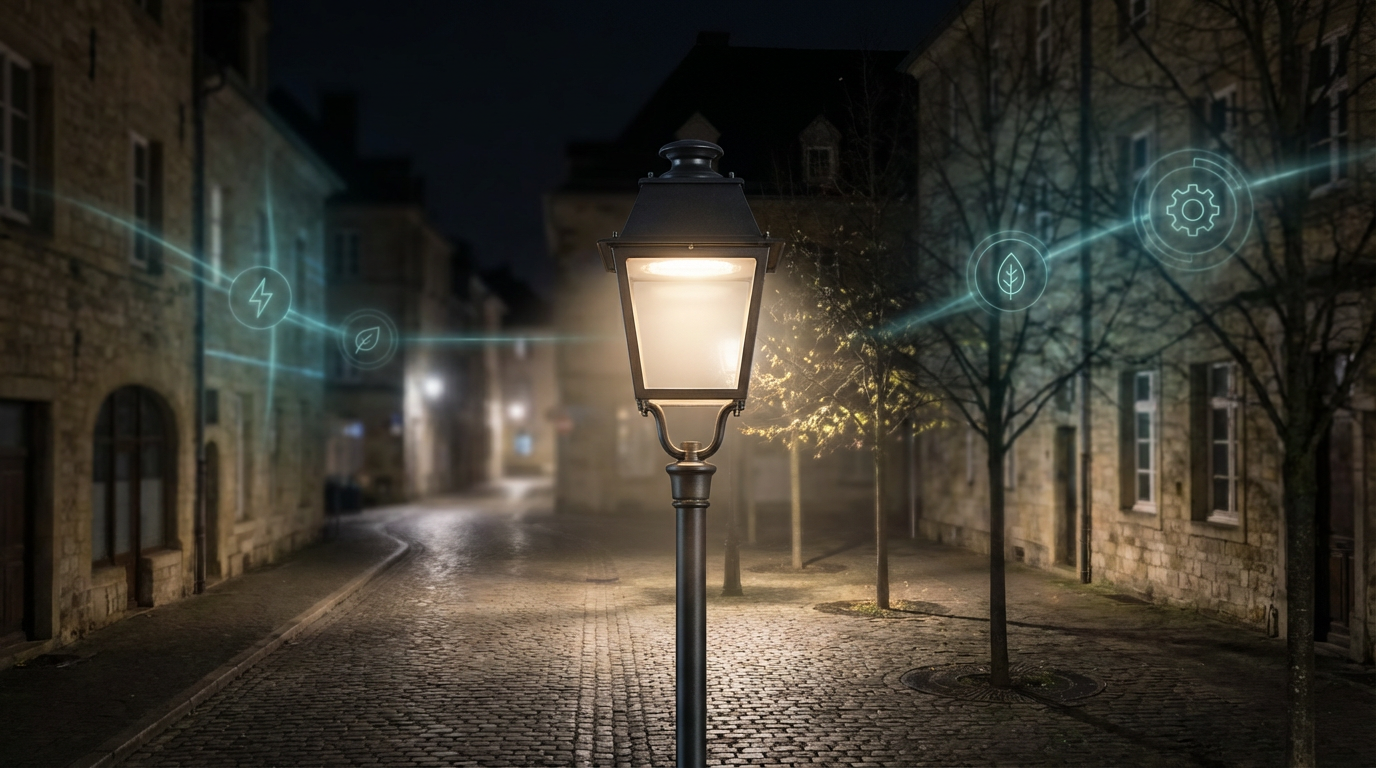
Biodiversity and Tunable White Drive new requirements
Another major trend influencing retrofit decisions is biodiversity protection. Fixed, high-CCT lighting is increasingly recognised as harmful to insects, birds, and nocturnal wildlife. Municipalities are now expected to implement lighting strategies that adapt to ecological sensitivity and time of night.
Tunable white LED technology makes this possible. By dynamically shifting colour temperature—often down to 2200–2400 K during low-activity periods—cities can reduce blue-rich light while maintaining safety. Importantly, tunable white does not require new luminaires when implemented through well-designed LED inserts. Adaptive, biodiversity-friendly lighting can be achieved within existing housings.
Why Generic Retrofit Solutions are no longer enough
As retrofit projects become more ambitious, expectations are rising. Municipal engineers increasingly demand predictable photometry, glare control, thermal stability, and long-term reliability. Generic “one-size-fits-all” LED inserts often struggle to meet these requirements.
Each luminaire housing has unique optical and electromagnetic characteristics. If these are not accounted for, retrofit projects risk uneven light distribution, overheating, EMC interference, or premature component failure. These issues can undermine trust in retrofit solutions and lead to costly corrections later.
AI-Driven Engineering reduces Retrofit Risk
Advanced retrofit strategies now rely on digital modelling and AI-based luminaire cloning. By accurately recreating the internal geometry and optical behaviour of an existing luminaire, LED inserts can be engineered specifically for that housing.
This enables precise control of light distribution, thermal performance, and compliance testing—before installation begins. When combined with EMC testing inside the actual luminaire housing, this approach delivers a level of predictability and reliability that municipalities increasingly expect from modern lighting projects.
Luxega applies this methodology to ensure that retrofit solutions behave exactly as planned in real-world installations, not just in laboratory conditions.
When Replacement still makes sense
A retrofit-first strategy does not mean replacement is never necessary. Severely corroded housings, damaged structures, or major urban redesigns may justify new luminaires. However, these cases are becoming the exception rather than the rule.
For the majority of street lighting networks, retrofit solutions offer a faster, more sustainable, and more economical path forward.
Conclusion: Retrofit-First is a Strategic Choice
The future of smart street lighting is not defined by replacing everything—it is defined by using existing assets more intelligently. Retrofit-first strategies allow municipalities to meet energy targets, protect biodiversity, enable smart controls, and reduce environmental impact at the same time.
As technology advances, LED inserts are no longer a compromise. When engineered with precision, they become the most responsible way to modernise public lighting—today and for decades to come.
Start the Journey today
No matter which type of luminaire you have we can help you to manufacture a perfectly fitted LED insert with all safety documents in place. The first step is to book a meeting with us.